TL;DR
- There is no right number of skills. Ask of each item when it loads, and what you pay for it while you are not using it.
- CLAUDE.md has a size target. Anthropic's docs say under 200 lines per file. Imports tidy a long file without making it cheaper.
- MCP advice online is often out of date. With tool search on by default, only tool names and server instructions load at session start.
- Measure, then cut.
/contextshows your real numbers. Move workflow text out of CLAUDE.md first.
Is there a right size?
No fixed number. Installed is not loaded: a good setup keeps always-loaded text short and puts depth where it loads on call. Anthropic's docs put it plainly: you don't need to configure everything up front.
The size target for instructions is under 200 lines per CLAUDE.md file, because longer files consume more context and reduce adherence. For everything else, the useful question is when it loads.
A Hacker News thread, "Ask HN: What's your current AI agentic setup?", asks which tools people run, and had drawn 695 comments by 9 November 2026. It asks what people run. This post asks when each part loads and what it costs.
What loads before you type?
CLAUDE.md, auto memory, MCP tool names and skill descriptions all enter context before your first message. Auto memory brings in the first 200 lines or 25KB of MEMORY.md, whichever comes first.
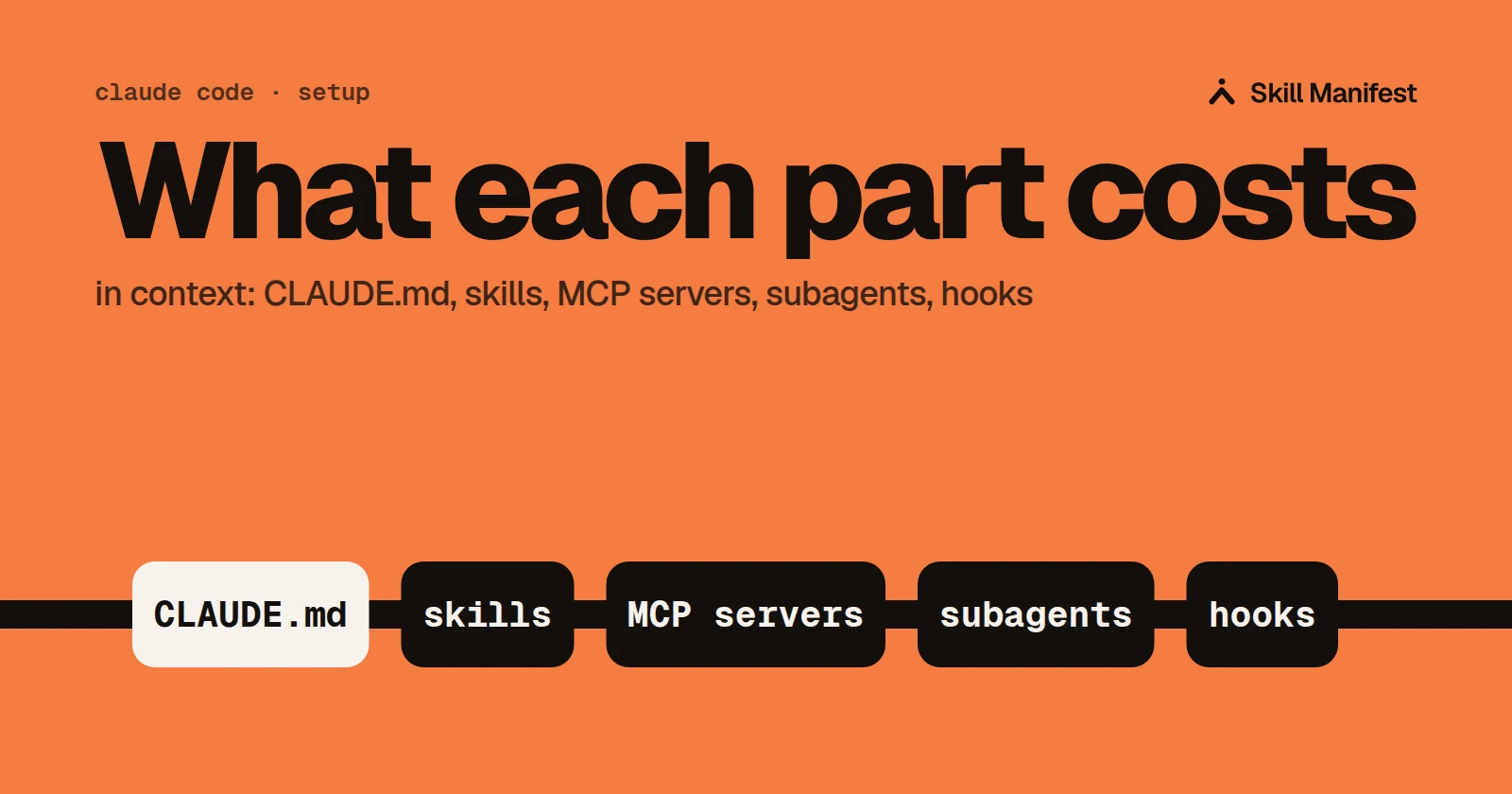
Full skill bodies and MCP tool definitions load on call. Skill names and descriptions, and MCP tool names, load at session start. Here is the whole model in one table.
| Part | Paid on every session | Paid only on use | Watch for |
|---|---|---|---|
CLAUDE.md | The whole file | Nothing extra | Under 200 lines per file |
@ imports | The imported text too | Nothing extra | They organize; they do not save |
| Path-scoped rules | Nothing until matched | The rule, on matching files | Good home for language or folder rules |
| Skills | Name and description | The full body, when invoked | The listing has a budget |
| MCP servers | Tool names, server instructions | The tool's definition | Each still adds to the list |
| Subagents | Description | Their work runs apart; you get a summary | Keep descriptions short |
| Hooks | No listing; the command runs outside the model | Output that reaches Claude | Noisy stdout |
What does each part cost?
CLAUDE.md and rules. Imports organize a long file but do not reduce its context cost. Splitting one file into five imported files saves nothing. Path-scoped rules do save, because they load only when Claude works with matching files.
Skills. Every skill in the listing adds to context on every turn, whether or not Claude uses it. The full body loads only when invoked, so the description is the part you pay for every turn.
The listing has limits. Its budget scales at 1% of the model's context window, and each entry's combined text is capped at 1,536 characters. Overflow is where a big collection starts to hurt: Claude Code drops descriptions, starting with the skills you invoke least.
For a skill only you call, set disable-model-invocation: true. That removes it from Claude's context entirely. After compaction, skill bodies come back, but large ones are truncated.
MCP servers. Some guides still say a server adds its whole tool list at session start. Current docs say only tool names and server instructions load at session start, so adding servers has a minimal effect on context. Each server still adds its tool names. If a command-line tool does the job, it is more context-efficient, because it adds no per-tool listing.
Subagents. Their descriptions take up context, so keep them short. Their work does not: your main conversation only receives a summary. A subagent can also carry an MCP server of its own, and the parent conversation doesn't get those tools. What background agents do to the bill is a separate question, covered in what background agents cost.
Hooks. A hook runs outside the model, and the cost is what it returns. Plain text written to stdout can go to Claude's context from some hooks. The same mechanism can save context: the docs give an example of a hook filtering a log from tens of thousands of tokens to hundreds.
Can too much make it worse?
Yes, and the cost is not only tokens. Anthropic's docs warn that too many features can add noise that makes Claude less effective: skills may not trigger correctly, or Claude may lose track of your conventions.
So a setup can fit in the window and still be too big. /skill-doctor shows how often each skill gets used, and a crowded listing loses the least-used descriptions first.
How do you measure yours?
Three commands, run in a fresh session.
/context        live breakdown of context use by category
/skill-doctor   what each skill costs and how often it gets used
/mcp            configured servers, and the switch to disable them
Run /context in a fresh session, before you ask anything. That is your standing cost, and the breakdown names which CLAUDE.md and auto memory files loaded. Run it before and after installing anything. Our field guide covers what loads and when, and lessons 1 to 3 are free with no account.
Exercise. Sort your own files into three lists: always loaded, loaded when called, and runs outside the model. Two shell commands give you a first size for each list:
wc -lc ~/.claude/CLAUDE.md CLAUDE.md .claude/CLAUDE.md 2>/dev/null
du -sh .claude/skills/*
What we run
We keep the always-on part small and put the depth in skills. Measured in our own repository:
| Where | Size |
|---|---|
Project instructions, two CLAUDE.md files | 116 lines, 12,274 bytes |
| Six skills and their supporting files | 163,022 bytes |
| One reviewer subagent | 1,813 bytes |
That is about 13 times as many bytes in skills as in instructions, by our arithmetic, and none of those skill files loads in full at session start. These are file sizes at one commit, not token counts. They show the shape: a short always-on layer and a deep on-call one. Each skill's name and description load at the start, and the full skill content loads only when invoked.
What should you cut first?
In this order:
- Workflow text in CLAUDE.md. Moving specialized instructions into skills keeps your base context smaller. If a paragraph matters only during a release, it is a skill.
- Skills
/skill-doctorshows you never use. Delete them, or setdisable-model-invocation: trueon the ones you call by hand. - MCP servers you are not using. Disable them from
/mcp. - Chatty hooks. Return less to stdout.
Run /context again after each change, and keep the change if the standing cost fell. Read what a component can do before you install a replacement.
To find a small component that does one job, Explore held 14,426 components with 2,675 reviewed on 9 November 2026, each with its source.
Sources
- code.claude.com/docs/en/context-window
- code.claude.com/docs/en/memory
- code.claude.com/docs/en/skills
- code.claude.com/docs/en/mcp
- code.claude.com/docs/en/costs
- code.claude.com/docs/en/sub-agents
- code.claude.com/docs/en/features-overview
- code.claude.com/docs/en/hooks-guide
- news.ycombinator.com/item?id=50366117
- skillmanifest.co