TL;DR
- The subagent's own requests are the bill to watch, not the status line. They draw on your usage on top of the main conversation's. In one small run of ours on v2.1.318, summaries were 0.4% of session cost, the subagent 57.3% and the main conversation 42.2%.
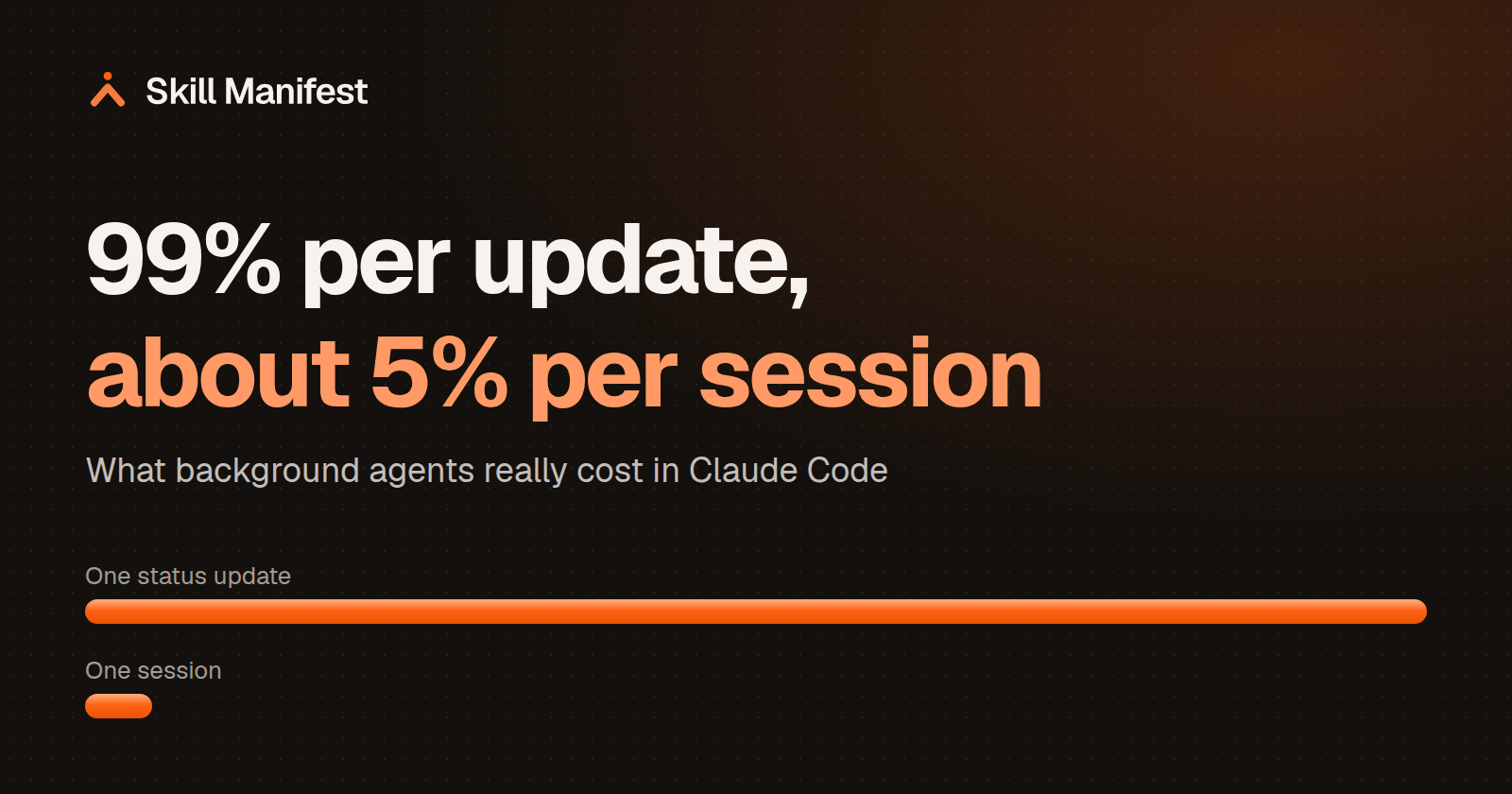
- On 4 November, each update got much cheaper. Haiku 5.5 now writes it from short notes, about 99% less per update, Anthropic says, on v2.1.316 or later. We saw about 96% at small context.
- Sessions with background subagents used only about 5% less of the limit. Before the change, Anthropic put summaries at about 2% of cost across users who send telemetry, and about 6% in the terminal.
- Telemetry off can keep you on the old method. Our one run with
DISABLE_TELEMETRY=1did, as did one independent test. Anthropic has not confirmed it.
What was the status line costing?
A running subagent updates its status line about every 30 seconds. Each update is a summary request, and the rest of this post calls them summaries. With nothing configured, a subagent Claude spawns from the main conversation starts in the background. Anthropic's Edwin Arbus said on 29 October that summary calls apply only to background agents actively working, and that idle agents don't get them.
Before the 4 November change, and still on setups it does not reach, each summary re-read the agent's whole conversation. People published very different numbers for what that cost, and they measured different things.
| Who measured | What | Summary share | Measure |
|---|---|---|---|
| Anthropic | Users who send telemetry, week before 29 October | About 2%, or about 6% in the terminal | Cost at API list prices |
| Anthropic | Same group | Just under 4% | Requests |
| Better Stack | Three agents building a TanStack Start site | 8.2% | Reported session cost |
| Better Stack | One agent running eight sleep 20 calls | 12.2% ($0.0030 of $0.0245) | Session cost |
| Flamerix AI | One team, one week | 16.4%, against 15.7% for the main conversation | Estimated spend |
| One GitHub reporter | One 4-hour session, 27 subagents, 1,496 requests | 22.7% | API requests |
All of these predate the change. Read them as a range, not a current rate.
Why they differ. An average across everyone sending telemetry likely includes people who run few agents or none. A week of one agent-heavy team does not. Requests and cost are different measures too.
Cost is not always a bill. Flamerix's figure is Claude Code's own per-request estimate. On a subscription, what you lose is rate-limit headroom. Token counts mislead as well: cache reads on Opus 5.5 and Sonnet 5.5 cost 0.05x the base input price, so a mostly cached summary was cheaper than its size suggests.
What we measured
We ran one background subagent over 5 tiny Python files, about 2.5 minutes of work, on Claude Code 2.1.310 and 2.1.318. Sonnet 5.5 was both the main agent and the subagent.
These are single runs on one small task, with 18 to 28 messages of agent context. They are not a benchmark, and we did not test a long-context agent. Dollar figures are estimates at API prices, because we run on a subscription. Summaries came about every 30 seconds and stopped when the subagent finished, which fits what Arbus said.
The old method re-reads the agent's whole conversation for each summary. The new one has Haiku write it from short notes.
| Measure | 2.1.310 (old method) | 2.1.318 (new method) |
|---|---|---|
| Main conversation, share of cost | 39.9% | 42.2% |
| Subagent, share of cost | 50.7% | 57.3% |
| Summaries, share of cost | 9.4% ($0.0169, Sonnet) | 0.4% ($0.0007, Haiku) |
| Session total | $0.1804 | $0.1743 |
| Cost per update | About $0.0042 | About $0.00018 |
The summaries' share nearly vanished. What remains is the main conversation and the subagent. Do not read the gap between the two totals as a saving: the other shares moved too, and each total is one run.
The per-update drop is roughly 96% at this small context size. That does not confirm Anthropic's 99%. It is one run on one small task.
Why does a 99% cut save only about 5%?
The two figures measure different things. On 4 November, Anthropic moved the summaries to Haiku 5.5, working from short notes instead of the whole conversation. The 99% is one update. The 5% is for whole sessions with background subagents. Anthropic also says the subagent keeps its own model, so the change does not touch the model doing the agent's work.
A cut to one kind of request moves a session's total only by that request's share of it. Both figures can be true, and the per-update saving is not a fixed number either. The other independent before-and-after we found is from Claude Code Lab, a Japanese-language blog, on v2.1.318 (macOS, Max plan, one agent, about 3 minutes):
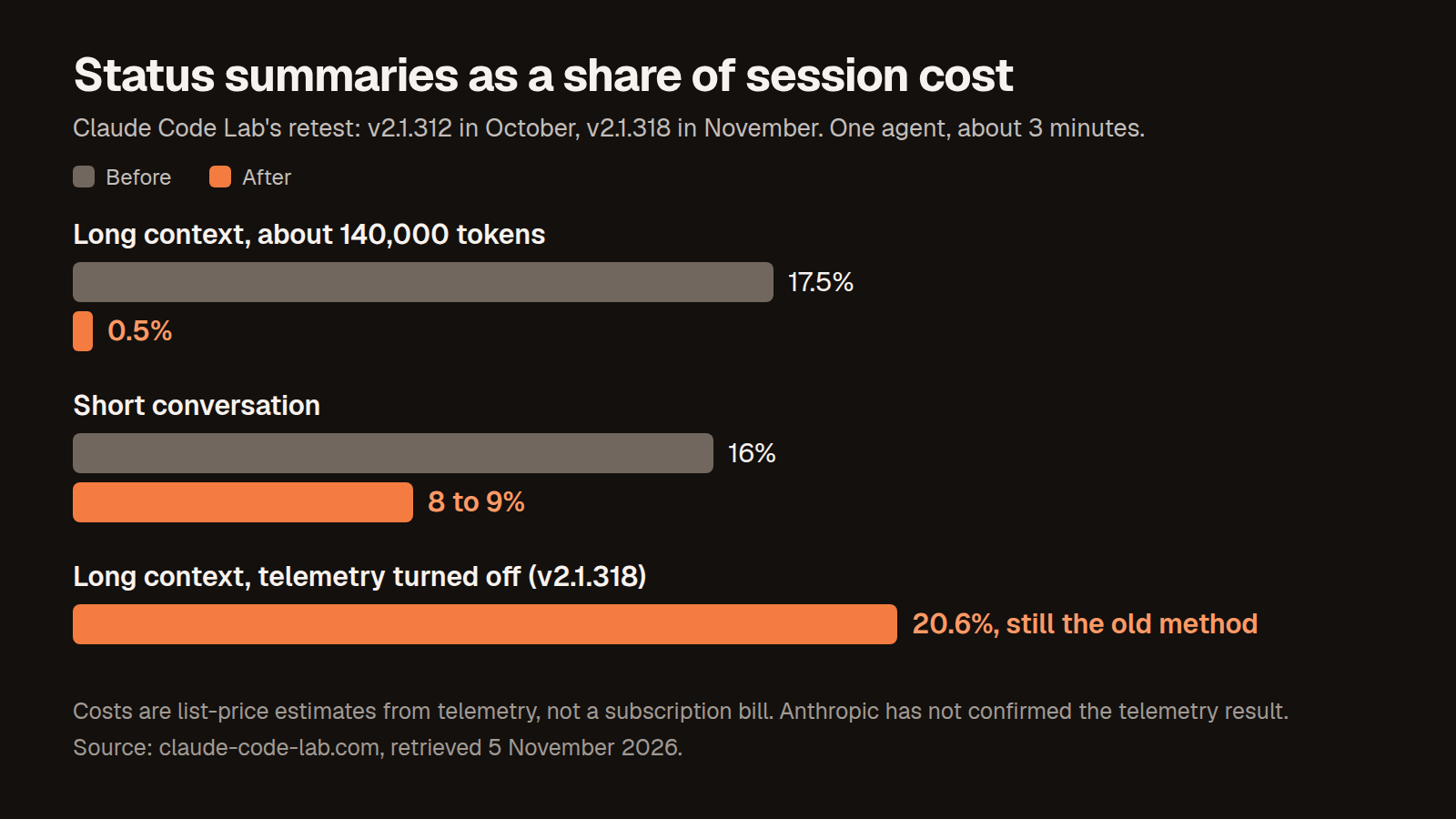
- Long context, about 140,000 tokens. Cost per summary fell about 97%. The summary share went from 17.5% to 0.5%.
- Short conversation. Cost per summary fell only about 40%. The share went from 16% to 8 to 9%.
In the Lab's two cases the saving was larger with more context, which fits the old method paying for the whole conversation and the new one for a short note. Our run does not fit that: at 18 to 28 messages we saw about 96%, where the Lab's short conversation saw about 40%. The setups differ and we do not know the cause, so measure yours.
You can scale the long-context case to your own day: updates per hour, times cost per update. One update every 30 seconds is 120 an hour. The Lab measured $0.00734 per summary before and $0.00024 after, which gives its hourly estimates of about $0.88 and about $0.03. Both rows are list prices, and ours assumes every agent works nonstop with that much context:
| Long-context agents | Old method | New method |
|---|---|---|
| 1 agent, 1 hour (the Lab's estimate) | About $0.88 | About $0.03 |
| 4 agents, 8 hours (our arithmetic) | About $28 | About $0.92 |
The Lab itself points out that Anthropic's 5% is an average across users, with conditions unlike its test.
How do you check that you have the new method?
Two conditions come first. Anthropic says you need v2.1.316 or later, and that the change is live for most Pro, Max and Ultra users and for everyone on Team and Enterprise. "Most" is the word to notice.
The debug log tells you, using the Lab's method. Start an interactive session, run a background subagent for over a minute, then look for the summary lines:
claude --version                          # 2.1.316 or later
claude --debug-file ~/claude-debug.log    # any path; interactive, then start one background subagent
grep AgentSummary ~/claude-debug.log
This works only in an interactive session. With claude -p we got no AgentSummary lines at all, on either version, even though the subagent ran 100 to 160 seconds. An empty result from print mode tells you nothing.
These are the lines from our logs:
# 2.1.318, defaults: the new method
[AgentSummary] Asking claude-haiku-5-5 for summary from 1017 characters of notes

# 2.1.310, defaults: the old method
[AgentSummary] Forking for summary, 22 messages in context
Delete the log afterward. It contains your conversation, and with telemetry on, ours also held the account email and ids.
The exception: telemetry off
Our one run on 2.1.318 with DISABLE_TELEMETRY=1 logged the old method: Forking for summary, 18 messages in context. The Lab got the same result with DISABLE_TELEMETRY=1 or CLAUDE_CODE_DISABLE_NONESSENTIAL_TRAFFIC=1, and in its long-context case summaries were 20.6% of session cost.
This matters if your company turns those settings on as a policy. Keep the caveats attached:
- Anthropic has not confirmed it. The Lab infers a feature flag. The docs say some features are turned on through flags fetched from Anthropic, and that some sessions skip the fetch, but they do not name this change.
- The changelog fits, without settling it. One entry treats summaries "on Bedrock, Vertex, Foundry, or with telemetry off" as a separate case.
- Some setups are untested. Neither we nor the Lab ran Bedrock, Vertex or Foundry. We did not test
CLAUDE_CODE_DISABLE_NONESSENTIAL_TRAFFIC, macOS or versions 2.1.311 to 2.1.317.
The Lab's 20.6% is its long-context case, so yours may differ. If a telemetry setting is a policy decision where you work, run the log check first and take your own number to whoever owns that policy.
How do you measure your own share?
Skip anyone's percentage, including ours. Three tools help with your own work.
/usage. On a Pro, Max, Ultra, Team or Enterprise plan, it shows your share of recent usage by skills, subagents, plugins and MCP servers. On 2.1.318 it shows no summary category. The cost sits in the Haiku line of a session's model breakdown: $0.0010 with summaries on and $0.0001 with them off, in our runs.
The OpenTelemetry cost counter. It splits cost by query_source: main, subagent or auxiliary. Summaries have no value of their own. They sit in auxiliary, and we picked them out by model.
The debug log. It shows which method you are on, not what it costs, and only in an interactive session.
One trap for tools that read your local files. Better Stack found, before this change, that summary requests appeared in exported telemetry and not in the local JSONL transcripts. A dashboard built on those files could miss them. We have not retested that, so check it on your version.
What actually keeps the bill down?
Spend less on the agents' own work. In our run the subagent and the main conversation were over 99% of the total, and in the Lab's long-context case the agent's work alone was 97%. The docs describe the same mechanism: the subagent's own requests still draw on your usage, on top of the main conversation's. The steps below are ours, and the reasons come from that page:
| What to change | Why it works |
|---|---|
| Set a smaller model on the subagent | The docs suggest model: haiku for simple subagent tasks, or running every subagent on one model |
| Run fewer subagents | Every subagent sends its own requests on top of the main conversation's |
| Give each subagent less to read | Token costs scale with context size |
| Check session recap and idle compaction | Both can use tokens while you are idle, and the docs say how to turn each off |
| Turn prompt suggestions off if you don't use them | Each one sends a short request after Claude responds |
The Lab says other background requests, such as prompt suggestions and session naming, did not change on 4 November. Together they came to about 9% of its short conversations, about the same as the summaries' 8 to 9%.
Agent teams are a separate question. Their token usage scales with the number of active teammates and how long each runs, and each active teammate keeps consuming tokens until it exits or the session ends. So shut them down when the work is done. The docs' "approximately 7x" has a condition: it applies when teammates run in plan mode. It is not a figure for background subagents.
What we do. We use the cheapest model that fits: Haiku for searching, Sonnet for coding, Opus for review and hard calls. We have not measured the difference, so take that as a habit and not a result. The one saving we can show comes from a different workload: stopping repeat reviews in our content engine, at about $1 per judge round. That is an engine cost, not a background-agent cost. Before you tune models, look for work your agents repeat.
Which settings stop the summaries?
We tried three settings, in four interactive runs on the same task. Each run logged 0 [AgentSummary] lines. We did not compare cost between settings, because we did not repeat the runs.
CLAUDE_CODE_FORK_SUBAGENT=0. The docs describe it as turning fork mode off and say nothing about summaries. On 2.1.318 and on 2.1.310, the subagent still ran in the background. One Linux report on v2.1.312 still saw 5 summary calls, while the Lab's macOS run on the same version saw none. The results conflict, so count the calls yourself if you rely on it.CLAUDE_CODE_DISABLE_BACKGROUND_TASKS=1. This one has a clear effect and a clear price. Claude waits for subagents to finish, and background commands are off too. On 2.1.318 the subagent ran in the foreground.CLAUDE_CODE_DISABLE_AGENT_PROGRESS_SUMMARIES=1. On 2.1.318 the subagent stayed in the background. It is undocumented: we found it in the 2.1.318 binary, it is absent from the 2.1.310 binary and from the docs page of environment variables, and it could change without notice.
Our view: on the new method, these are not worth your time. Our summaries cost $0.0007 of a $0.1743 session.
What to do next
Run the three commands above in an interactive session on one real task, then delete the log. If it says Asking claude-haiku-5-5, stop worrying about the status line and open /usage. Find the subagent with the largest share, set model: haiku on it, and rerun one real task. Compare the subagent's share in /usage before and after, and keep haiku only where the output is unchanged.
If you are new to subagents, lessons 1 to 3 of the field guide are free, and the context lesson explains what loads and when.
Sources
- code.claude.com/docs/en/sub-agents
- code.claude.com/docs/en/costs
- code.claude.com/docs/en/monitoring-usage
- code.claude.com/docs/en/env-vars
- code.claude.com/docs/en/changelog
- platform.claude.com/docs/en/about-claude/pricing
- x.com/ClaudeDevs/status/2118063143167693011
- x.com/ClaudeDevs/status/2118063144572772627
- news.ycombinator.com/item?id=50284699
- www.claude-code-lab.com/blog/claude-code-subagent-usage-haiku-summary
- betterstack.com/community/guides/ai/claude-code-token-costs
- gist.github.com/flamerix-ai/c3905705cc4205e5de3011fa2e74efce
- github.com/anthropics/claude-code/issues/86879
- github.com/anthropics/claude-code/issues/105981